
Thoughts on Strength
When Mel asked me to deliver a workshop on strength training for Kendal Wall Women’s Social, I leapt at the opportunity. It is a pleasure to share what I’ve learnt about just how beneficial and life-changing strength training can be — especially for women.
Keeping this topic simple is tricky, and we covered a huge amount in the workshop. We finished with an overwhelming feeling of psyche, but there still seemed to be a few hurdles before everyone felt able to bring strength training into their lives.
We all learn differently, so I wanted to create this reference tool with the information we covered, details that may have got lost, and an easy-to-follow ‘how-to’ summary.
Based on feedback, I’m also including an example of a general strength training programme aimed at climbers — useful if you don’t know where to start or if personal trainer/climbing coach costs aren’t feasible right now.

The try hard face of strength training! © Greg Nelson
Why should we bother to train strength?
Strength is the foundation of a healthy, resilient body that can do all the fun, exciting things we want to do. This includes being able to climb more and being able to try more strenuous moves.
When we talk about increasing strength, we’re talking about increasing the maximum force we can exert.
The benefits
Research over the last 10 years has hugely expanded our understanding of women’s physiology. We can now reliably say that, as a woman, if you consistently strength train for one hour or more per week, you can:
Increase bone density
As well as increasing bone density directly, it can also create a stimulus that partly replicates the role of oestrogen after menopause, supporting strong bones, a robust body and lower body fat.Improve heart health
Decrease your risk of type 2 diabetes
Decrease your risk of all types of cancer
Improve brain function
The protein synthesised during strength training is the same kind used to form new neural connections.Improve body image
Burn fat
It’s more effective than cardio for the same workout duration. This benefit will be disrupted if you are under-fuelled — i.e. fasted or low on carbohydrates.Regulate hormones and mood
This is particularly relevant during peri-menopause when hormone spikes can lead to fatigue, mood swings and poor sleep. All of this can be improved with kind, consistent, structured strength training.
More Science!
If you want to learn more about the science on this topic Stacy Sims is an excellent resource. She is an exercise physiologist and nutrition scientist (MSc, PhD) committed to educating women on how to work with their bodies. Everything she advocates is well-researched and applicable in the real world.
Before you dive in, it’s worth knowing that she strongly advocates power and high-intensity interval training alongside strength training (which she often refers to as resistance training). It could be easy to feel intimidated by all the possibilities of how to train — so my advice is to start with strength. It’s simple to implement, time-efficient and underpins everything else.
Suggested reading:
Resolve to Get Strong — Dr Stacy Sims
Finding motivation
I find strength training fun — but I haven’t always. Many people find it boring or struggle to stay motivated, and I’ve absolutely been there.
However, once you see the results in both your climbing and your life, motivation tends to follow. One reassuring thing about strength training is its clear progression: if you show up consistently and try appropriately hard, the numbers go up. That’s unarguable evidence that you’re getting stronger.
In a world where climbing progression is often hard to quantify, seeing progress off the wall can feel really reassuring.

When you feel the progression! © Alex Fry
Structuring strength training
Strength is relatively slow to build, but also slow to lose. To see a meaningful difference, commit to a programme for 6–8 weeks, then review and adjust.
Most people can train just once a week and see improvements. If you have the time, training more often will see your rate of progress increase, but make sure there is enough time between your sessions to recover, especially if you are training the same muscles.
The most important factors are consistency and trying hard during sessions so don’t over-commit.
Once you know how much time you have, your goals and weaknesses, and what equipment is available, you can choose your exercises.
Pick 4–6 exercises
Aim for a session of around 1 hour
This allows you to work hard without getting bored or too fatigued.
Warm-up and working sets
To reduce injury risk, warm up and start easy building up to your working weight.
For each exercise:
Begin with a set at ~50% of your working weight
Gradually increase the load each set
Reach your working weight, then complete:
3–5 sets
3–5 reps per set
The appropriate working weight is when you have to try really hard but don’t quite go to failure. A good rule of thumb: you should feel like you could complete 1 or 2 more reps if needed.
Rest 2-5 minutes between sets - long enough to feel rested but not so long that you cool down.
Keeping the number of reps low and the rests long will maximise your strength gains without making the muscles much bigger, which is exactly what we’re after as climbers.
Safe Progression
As you get steadily stronger you can build your reps and sets up, then increase the load, drop the sets/reps, and then repeat the cycle. This might look like:

Sets (reps × weight)
Session 1: 4 (4 × 10 kg)
Session 2: 5 (4 × 10 kg)
Session 3: 3 (5 × 10 kg)
Session 4: 5 (5 × 10 kg)
Session 5: 3 (3 × 12 kg)
Session 6: 4 (3 × 12 kg)
To make an exercise harder increase either volume (sets/reps) or load (weight) — not both. Otherwise you’re flirting with injury.
When your training programme includes new exercises, you will need a period of time to learn the movement before feeling confident to try hard. Don’t skip this stage, it’s important to avoid injury. For simple movements it won’t take very long, maybe just the first session.
Maximise the benefits
- You can only train as hard as you can recover -
To support recovery and results:
Hydrate and fuel before strength sessions
The emphasis is on carbohydrates and anything is better than nothing. It can look as simple as a glass of water and a banana, but fully fueled is better.Avoid being pre-fatigued
e.g. don’t go for a run before a heavy leg sessionEat after training
Aim for 20g+ protein within one hourPrioritise sleep
Even if you can’t change your current sleeping arrangements, understanding that this is one of the largest factors influencing recovery can help you listen to your body. If you haven’t slept well or just don’t feel good, keeping extra reps in reserve is a good idea.Record your training and if you are menstruating tracking your cycle can be helpful.
I use a week to view diary and include the day of my cycle next to the date. This helps me keep track of progress and uncovers any patterns.
Schedule a deload week every 4–6 weeks
Cumulative fatigue builds up week on week. Including a deload week can significantly reduce injury risk and improve gains. Aim to still show up for the strength session to maintain consistency, but decrease the number of sets you’re doing or go back down to a lighter weight for the session.
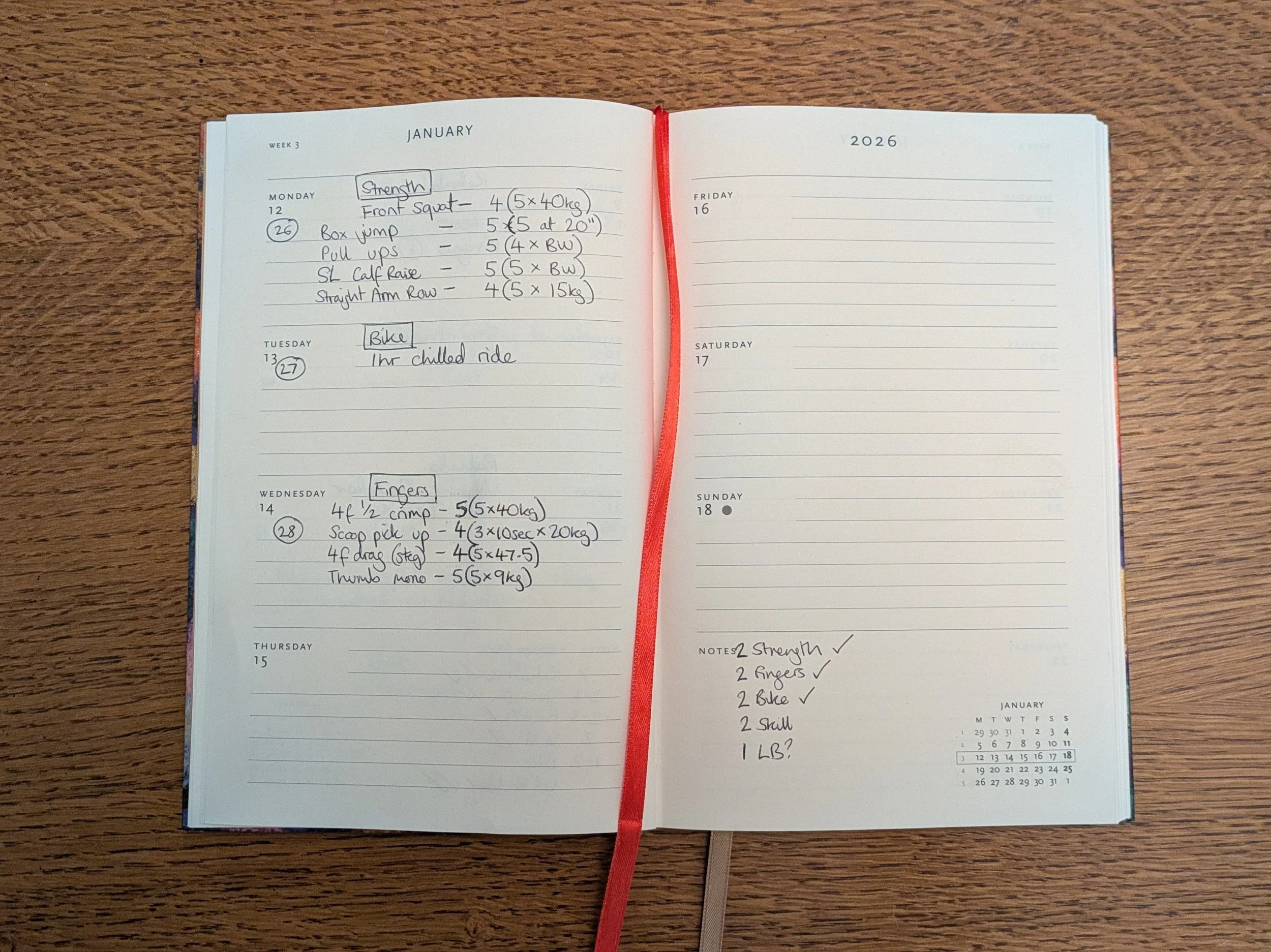
My training diary so far this week
Example: General strength training programme
Duration: 8 weeks
Frequency: 1 session per week
Working sets
3–5 reps
3–5 sets
1–5 minutes rest
2 reps in reserve
Exercises (with regressions/progressions)
Pull-ups
(Chair-assisted → banded → body weight → weighted)Arnold press
(Excellent antagonist exercise for shoulder health)
Video reference: Ollie Torr, Lattice Training — 3:34Glute bridge
(Floor → Elevated → single-leg → weighted single-leg)Goblet squat
(Lunges → box squat → goblet squat → weighted goblet squat)Leg raise
(Hanging knee raise → Leg raise → toes-to-bar)
Deload: Week 4 and Week 8
Session checklist
□ Hydrated?
□ Fuelled (carbs)?
□ Trying really hard?
□ 20g+ protein post-training?
□ Logged in training diary?
Why these exercises?
They cover the whole body:
Upper-body pull
Upper-body push
Lower-body hinge
Lower-body squat
Mid-body/core
They require minimal equipment and can be done at Kendal Wall.
Feel free to follow this programme as written or use it as a starting point. My one caveat: Listen to your body. There should never be pain — only effort and fatigue. There is always a regression or alternative exercise that can target the same muscles and work for your body.
More info and support
If you’d like personalised input, please get in touch with Mel or myself for 1-1 or small group coaching.
Alternatively, my husband John Kettle is one of the most experienced climbing coaches in writing training programmes for recreational climbers, and is also qualified to teach weight training.
Below are some recommended resources for those who want to learn how to write their own rock climbing physical training programme (off the wall strength training is just one facet of this):
Steve Bechtel’s book — Logical Progression (non-linear periodisation for climbing)
Climb Strong - Webpage with articles + free newsletter
Mercedes Pollmeier — Modus Athletica Webpage
Podcast: Modus Café: Conversations Beyond Climbing
At Kendal Wall Women’s Social next Monday (January 19th at 7:30pm), we’ll be looking at taking this theory to off the wall finger strength training. No need to book, just rock up.
See you there!